Introduction
When people talk about life cycle cost (LCC), it often sounds like a finance exercise. Something done once, in a spreadsheet, before equipment is purchased. In reality, for mining and earthmoving fleets, the LCC is not static. It is driven by how the asset is actually used, maintained, and managed over time.
If you are relying on assumptions or historical reports, you are not managing the costs correctly. You are reacting to it. This guide breaks down what life cycle cost actually means in practice, and why it matters for equipment performance, cost control, and decision making.
What is life cycle cost?
Life cycle cost is the total cost of owning and operating an asset across its entire life. It includes capital cost, operating cost, maintenance cost, and disposal cost. In simple terms:
LCC = Capital + Operating + Maintenance − Disposal
This framework has been used for decades in mining equipment selection and planning, because it forces a complete view of cost, not just the purchase price.
Why life cycle cost matters in mining equipment
For mobile equipment, revenue depends on uptime and productivity. That means cost is not just about what you spend, but how it affects performance.
A lower upfront cost can lead to higher maintenance and downtime. A more expensive machine may deliver better reliability and lower long-term cost. The LCC method allows you to compare those trade-offs properly.
More importantly, it gives you a way to understand true cost per hour, the impact of maintenance strategy, when an asset becomes uneconomical, and where cost risk is building. Without it, decisions are based on incomplete information.
The components of life cycle cost
Capital cost
This is more than just the purchase price. It includes acquisition, freight and assembly, commissioning and training, and supporting infrastructure and tooling.
In many cases, these supporting costs are underestimated or ignored, which distorts the true life cycle cost from the start.
Operating cost
Operating cost is driven by how the machine is used. Typical inputs include fuel, tyres, operator cost, and wear items. These costs vary significantly depending on conditions such as haul distance, load, road quality, and operator behaviour.
This is where assumed models often fall apart. Real usage rarely matches the assumptions.
Maintenance cost
Maintenance is where life cycle cost becomes controllable. It includes running repairs, preventative maintenance, major component rebuilds, and structural repairs.
A structured maintenance plan defines service intervals, component life, parts and labour requirements, and rebuild timing. These inputs directly determine long-term cost.
Disposal cost
Disposal is often treated as an afterthought. In mining and earthmoving, residual value is highly variable and often overestimated. In some cases, the cost of demobilisation offsets any resale value.
Ignoring this leads to overly optimistic estimates.

Life cycle cost (LCC) vs maintenance strategy
One of the most important points often missed is that LCC is not separate from maintenance strategy. It is driven by it. Change the maintenance strategy, and you change the cost structure.
Increasing preventative maintenance may increase short-term cost but reduce major failures. Extending component life may reduce rebuild frequency but increase failure risk. Improving inspection quality may reduce unplanned downtime.
LCC gives you a way to evaluate these trade-offs properly instead of guessing.
Where most models fail
Most businesses understand the concept of life cycle cost. Where it breaks down is in execution.
Models are built once and never updated. They rely on fixed assumptions. There is no link between actual work and the cost model. Costs are captured after the fact, with no visibility into future changes.
Over time, the model drifts away from reality and stops being useful for decision making.
What a useful life cycle cost model looks like
For a model to be practical, it needs to stay aligned with real operations.
Costs must be driven by actual maintenance tasks. Component lives need to be tracked and updated. Work orders should feed cost data automatically. Forecasts must update as the fleet changes.
It needs to be continuous, not static.
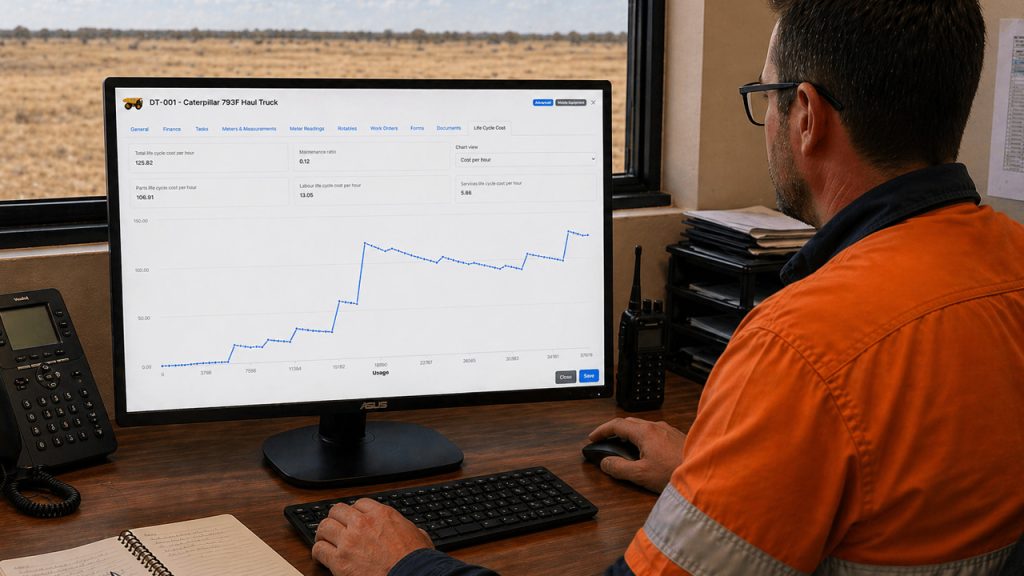
When that happens, it can be used as a live tool for forecasting future spend, identifying cost risk early, supporting repair versus replace decisions, and setting accurate cost per hour.
What this means in practice
When done properly, you are not surprised by major spend. Maintenance becomes predictable. Cost per hour reflects reality. Decisions are made earlier, not after failure. Asset performance and cost are understood together.
Conclusion
LCC is not just a calculation. It is a way of understanding how your fleet performs over time.
For mining and earthmoving equipment, where cost, uptime, and risk are tightly linked, it becomes one of the most important tools available.
But only if it stays connected to reality.
A static model might help at the start. A continuously updated view is what actually improves decisions.
Click here to learn how Samurai hanldes life cycle costing.
Life cycle cost is the total cost of owning and operating an asset over its entire working life. For earthmoving and mining equipment, this includes purchase cost, maintenance, labour, fuel, tyres, rebuilds, downtime, and disposal or resale value.
It gives operators a clearer view of what a machine actually costs to run, not just what it cost to buy.
Construction and mining earthmoving equipment is expensive to own and highly sensitive to downtime. A machine with lower purchase cost can easily become more expensive over time if reliability is poor or maintenance costs escalate.
Understanding life cycle cost helps contractors and fleet owners make better decisions around maintenance strategy, rebuild timing, replacement planning, and equipment selection.
A basic life cycle cost calculation includes:
- Capital cost
- Operating cost
- Maintenance cost
- Disposal or residual value
The calculation looks at the total cost across the machine’s usable life, usually measured in hours.
Many businesses also calculate cost per hour to compare assets and understand long-term fleet performance.
The biggest factors are usually:
- Equipment utilisation
- Preventative maintenance quality
- Component life
- Unplanned failures
- Operating conditions
- Fuel and tyre consumption
- Downtime events
Poor maintenance execution often increases total life cycle cost far more than the original purchase price difference between machines.
Maintenance software helps by automatically capturing work orders, labour, component replacements, downtime, and maintenance spend as work happens.
This keeps life cycle cost calculations current instead of relying on manual spreadsheets or outdated assumptions.
With the right system, fleet owners can forecast future maintenance spend, track cost per hour, and identify assets becoming uneconomical earlier.
There is no single rule, but life cycle cost analysis helps identify when ongoing rebuild and repair costs begin outweighing the value of keeping the machine in service.
Factors usually include:
- Rising component failure frequency
- Increasing downtime
- Structural condition
- Availability impact
- Future maintenance forecast
- Residual value
Good maintenance data makes these decisions far easier and less reactive.
Ready to take control of your maintenance?
Samurai helps earthmoving and mining fleets capture maintenance properly at the source, reduce downtime, and stay in control of cost and performance across every site.