You didn’t pick a bad system by accident. On paper, most CMMS look the same. Work orders, schedules, reports, dashboards. The demo works. The sales pitch makes sense.
Then you roll it out across your fleet and something doesn’t stick. The crew works around it. Data comes in late. Planning falls apart. You’re back to spreadsheets, phone calls, and chasing updates.
It’s not because your team is resistant to change. And it’s not because you didn’t set it up properly. It’s because most maintenance management systems were never built for earthmoving fleets in the first place.
The real problem: factory systems trying to run mobile fleets
Most CMMS platforms come from one of two places. Manufacturing or facilities management.
In those environments, equipment is fixed in one place, work is predictable, schedules are calendar-based, and teams operate in controlled conditions.
That logic breaks the moment you apply it to mobile equipment.
Your machines move between sites. Work changes daily. Breakdowns happen in the field. Multiple crews, contractors, and shifts all touch the same asset.
What looks like a feature gap is actually a design mismatch.
And that mismatch shows up in three places straight away.
Calendar-based scheduling doesn’t match how machines are used
Most systems are built around time.
Service every 30 days. Inspect every week. Generate work orders based on dates.
That works for buildings. It doesn’t work for equipment.
An excavator that runs 10 hours a day needs servicing very differently to one that runs 3 hours a day. A haul truck working hard on a mine site doesn’t follow the same pattern as one sitting idle between jobs.
Earthmoving fleets run on hours, not dates.
When your maintenance management system can’t properly handle hour-based service intervals, services get missed or done too early, planning becomes reactive, and costs creep in without warning.
You end up managing the schedule manually anyway, which defeats the whole point of having a system.
This is one of the most common reasons a maintenance management system fails in heavy equipment environments. It looks right on paper, but it doesn’t reflect how machines actually work.
Component tracking is either missing or bolted on
In manufacturing systems, the asset is the asset.
In earthmoving, that’s not how it works.
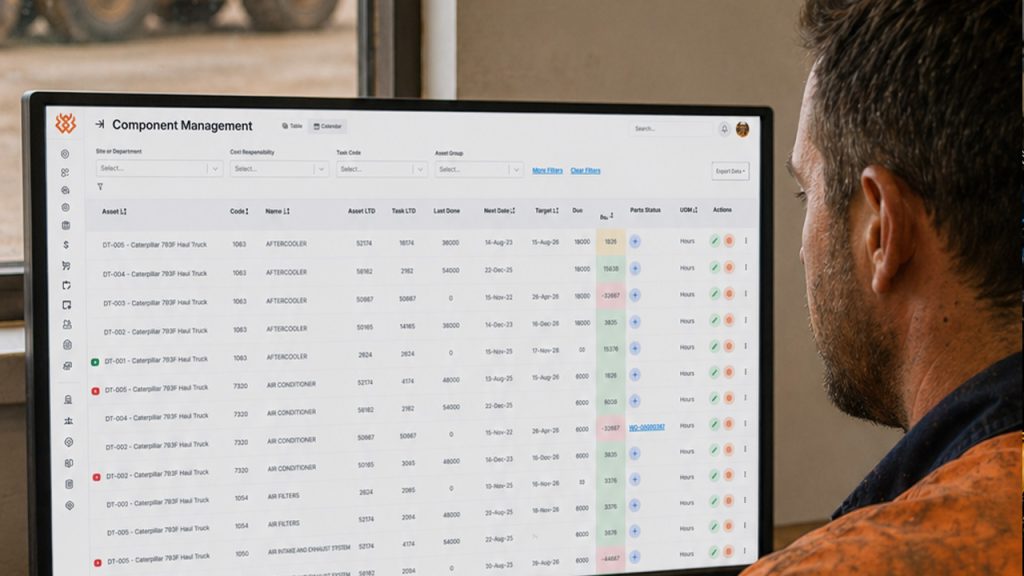
The real cost, risk, and downtime sit in the components. Engines, transmissions, hydraulics, final drives.
These don’t just get serviced. They get rebuilt, swapped, and tracked across machines over time.
Most CMMS platforms don’t handle this properly.
Best case, component tracking is a bolt-on. Worst case, it’s handled in notes, spreadsheets, or someone’s memory.
That creates real problems. You lose visibility of true component life. Costs get tied to the wrong machine. Rebuild decisions are made without reliable data. Forecasting becomes guesswork.
Over time, this is where margins disappear.
A system that can’t track components properly isn’t giving you control. It’s just recording history after the fact.
Multi-site fleets break centralised systems
Most CMMS platforms assume a single site or a tightly controlled environment.
That’s not how your fleet operates.
You’ve got machines spread across projects, regions, and clients. Work is done by internal teams, site-based fitters, and external contractors. Information flows through phone calls, radios, and quick decisions in the field.
Trying to force that into a rigid, centralised system creates friction.
What happens next is predictable. Crews bypass the system because it slows them down. Data gets entered later, if at all. Supervisors rely on calls instead of dashboards. Head office loses visibility.
You end up with a system that technically works, but doesn’t reflect reality.
And once that happens, trust is gone.
Data is captured after the job, not during it
This is where most systems quietly fail.
They rely on someone, usually after the shift, to reconstruct what happened.
Work orders get filled in from memory. Downtime is estimated. Notes are incomplete.
It looks like data, but it’s not reliable.
In earthmoving operations, timing matters. If information isn’t captured when the job happens, it’s either wrong or missing.
That has real consequences. Planning is based on incomplete information. Downtime disputes can’t be defended. Costs only become clear after the damage is done.
Most systems optimise for reporting. Very few are designed for real-time capture in the field.
If the system doesn’t fit how work actually happens, crews won’t use it. And if they don’t use it, nothing else matters.
So what works for earthmoving Equipment?
A maintenance management system only works when it matches the reality of your operation.
That means:
- Hour-based service scheduling, not calendar assumptions
- Native component and rotable tracking, not bolt-ons
- Multi-site visibility without adding admin
- Work captured at the source, not reconstructed later
It also means recognising something most vendors ignore.
Execution comes first. Control follows.
If the system helps your crew get the job done faster and with less friction, the data will be there. If it doesn’t, no amount of reporting or configuration will fix it.
That’s why so many fleets end up back where they started, with spreadsheets, workarounds, and a system no one trusts.
Not because they don’t need a maintenance management system.
But because they were sold one that was never built for them.
Ready to take control of your maintenance?
Samurai helps earthmoving and mining fleets capture maintenance properly at the source, reduce downtime, and stay in control of cost and performance across every site.